
Why the “Content Architect” will be marketing’s hottest job in 2026
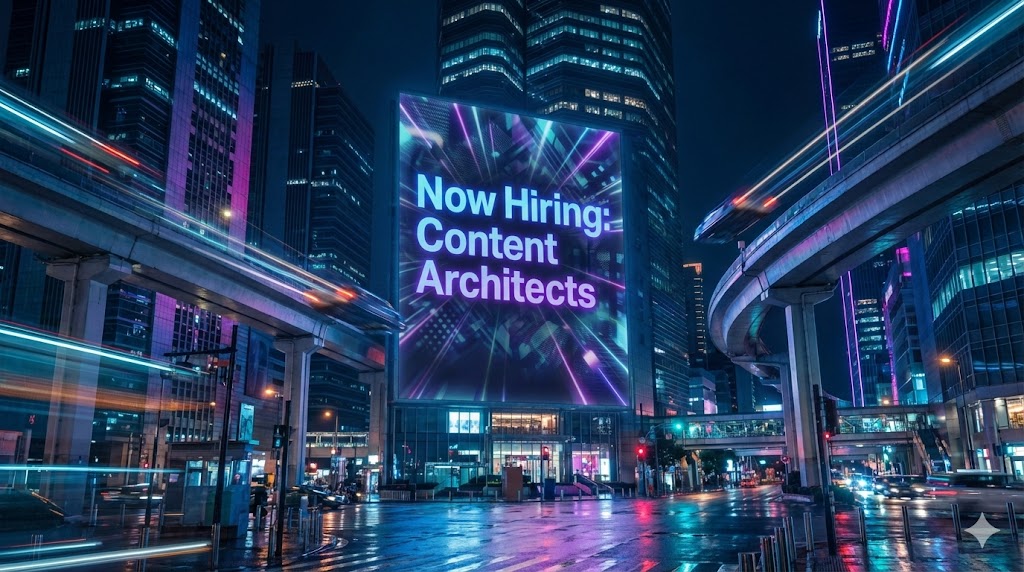
If you’ve been in the industry for a while you may remember when, years ago, job postings for SEO specialists were suddenly everywhere – when even a few months earlier many marketers hadn’t known what the term meant.
Then, it happened with social media managers. Programmatic traders. Influencer marketing managers. Now, these are well known industry mainstays.
Get ready to meet 2026’s addition: The Content Architect.
This leadership role is designed to meet today’s and tomorrow’s pivotal changes in marketing. That’s because today’s audience discovery and journey have changed faster than content teams and systems can adapt. AI-driven citations now drop visitors deep into websites, bypassing traditional landing patterns. Journeys compress from weeks into days. Engagement pathways multiply and fragment. And most strikingly, consumers increasingly report using AI tools before ever clicking into a brand’s site. This means most influence now happens upstream, beyond what analytics can see.
From Knotch’s vantage point across the many enterprise teams we work with, there’s a rising need for a role that sits above creation and distribution, responsible for making the entire content ecosystem coherent, discoverable, measurable, and scalable. We (and some others, like our friends at Acquia) call this the Content Architect. And you may be in the market for one already without even realizing it.
What Knotch means by “Content Architect” – and where to find one
We define the Content Architect as the person responsible for building and maintaining the structures that support a brand’s entire content ecosystem. It is a role that blends editorial thinking, journey design, data literacy, and systems design. It is not simply a seasoned content manager with some technical skills; it is someone who understands how stories, systems, audiences, and analytics interlock.
Strong candidates often come from roles like content strategy, UX/content design, or lifecycle marketing. These are disciplines that require broad thinking and empathy for how audiences move through information. Ideal candidates’ resumes tend to show a blend of editorial sensibility and operational influence. What distinguishes them, however, is their ability to think holistically. They have to show a track record of being able to see how narrative, taxonomy, governance, personalization, and performance can align to create a coherent content experience.
The skill set is equally hybrid. Hard skills include journey mapping, content model and system design, tagging and governance frameworks, and the ability to translate analytics into optimization strategies. Soft skills center on facilitation, cross-functional leadership, and systems thinking. They’re exactly the qualities needed to unite creative, technical, and analytical teams around shared goals.
Why this role is emerging now
Across brands in need of transformation, the symptoms appear long before the title does: Content is spread across multiple platforms and teams. Narratives are inconsistent across regions, sub-brands, or channels. Personalization initiatives stall because content isn’t structured for reuse. And governance models can’t keep pace with the volume of content being created, especially as AI accelerates production.
In these environments, even answering foundational questions such as What content do we have? Where does it live? How is it performing? becomes a time-consuming, cross-functional scavenger hunt.
Brands typically realize they need a Content Architect when the gaps become too costly to ignore. Content strategy, production, and measurement are often fragmented across teams and processes, creating inconsistent experiences and slow production cycles. The rise of AI-generated content accelerates this fragmentation. Personalization efforts break down because content isn’t structured for modularity or reuse. Regional teams rewrite the same assets because they can’t find or adapt what already exists. And analytics remain disconnected from content planning, preventing teams from knowing what to create or optimize next.
In this environment, someone must finally own the architecture of how content gets created, governed, measured, and evolved. Without that, content becomes expensive, slow, and ineffective. This happens regardless of how talented the individual creators are.
Forrester Research agrees. In its 2026 predictions, analyst Kathleen Pierce forecasts:
“A new generation of content operations leaders will emerge to adapt workflows and content strategy, modernize localization and taxonomy, guide subject matter experts, and transform professional content creators into modular content architects.”
As always, not all verticals will be on the same hiring timeline for a role like this. We expect early adoption to come from categories where content volume is high and journeys are complex – for example, financial services, healthcare, pharma, retail, travel, and tech/SaaS. These industries rely heavily on structured content, sophisticated martech stacks, and personalized or multi-step customer experiences. Both mid-size and enterprise organizations with mature digital capabilities but fragmented content practices will feel the urgency most acutely.
These high-consideration categories have long journeys, and heavy storytelling needs. Many also are subject to regulatory constraints. As a result, they’re particularly well suited to benefit from hiring a Content Architect sooner rather than later. Impulse-driven brands will feel less pressure, but any business that depends on trust, clarity, or repeated touchpoints will see the value soon.
Will these roles be in-house or agency? It’s a blend of both
One question that always comes up whenever a new marketing role will be discussed: Will this be in-house or agency?
The answer is usually a blend of both, and this is no exception. Knotch expects Content Architects to emerge inside large and mid-size organizations as well as within agencies that offer advanced content, CX, and digital transformation practices. Inside a brand, the role will become a strategic anchor that’s responsible for aligning teams, platforms, workflows, and measurement frameworks. In agencies, it will evolve into a premium strategic layer that sits above execution, helping clients design the content systems and playbooks that make personalization, generative AI, and omnichannel experiences possible.
How a Content Architect reshapes an organization
Introducing a Content Architect often forces a shift in how an organization thinks about content altogether. Rather than living loosely between brand, product, UX, and digital, content strategy becomes centralized within marketing or customer experience, with the architect guiding the structure beneath it. In many organizations, this role will report to a VP of Marketing, Head of CX, or Chief Digital Officer.
From this vantage point, the Content Architect may oversee content strategists, UX writers, content operations specialists, or lifecycle marketers; alternately, they may serve as the connective tissue across these teams. Their influence extends from storytelling to taxonomy, from editorial calendars to personalization frameworks, from content governance to the foundational data models that support AI-powered content experiences. They ensure that the entire ecosystem evolves cohesively rather than by accident.
What success looks like in the first six months
So you’ve hired a Content Architect. How do you know they’re succeeding? Our view of this role is grounded in the milestones that we see high-performing organizations achieve. In the first month, a successful Content Architect completes a full audit of journeys, content workflows, governance, and technology gaps. Their KPI is alignment: defining a clear set of priorities that the organization agrees to tackle.
By three months, they begin delivering the architecture itself – taxonomies, content models, journey maps, and playbooks that define how content should flow across teams and platforms. The markers of success here are adoption and clarity: teams understand the system and begin to operate within it.
By six months, the architect activates the model. This might include launching personalization pilots, improving conversion pathways, or implementing content scoring and performance frameworks. At this stage, success is measurable: better engagement, faster production cycles, more efficient reuse, or higher conversion efficiency.
Why the Content Architect will become essential in 2026
Marketing has always created new roles in response to technological shifts. SEO specialists emerged when Google changed discovery. Social media managers appeared when social platforms became brand channels. Marketing automation leads surfaced when CRM capabilities matured.
The rise of AI-assisted discovery, fragmented journeys, content acceleration, and the dual audience of humans + machines has created another such moment. In 2026, brands will realize that they’ll benefit from hiring a Content Architect. But before long, they’ll need one to remain competitive.
Published December 18, 2024
Become a thought leader
Become a thought leader

.jpg)







Trusted by the largest (and now smartest) brands in the world.
“Before Knotch we did not understand what content was driving business results. Now we understand which content moves the needle. Knotch’s cohesive reporting and insights paint a real picture of what’s happening on our website instead of the patchwork quilt that comes from a Google Analytics approach. With Knotch we have been able to re-prioritize ad spend, route better leads to our SDR team, and inform our content development initiatives.”

"The Knotch platform ensures that we deliver high-performing content tailored to young home shoppers, enhancing their experience and driving better business outcomes.”

"Our partnership with Knotch has been highly successful, empowering us to leverage data-driven insights and refine our content strategy.”
