
Introducing Ace for Agents: Atoms, Not Pages
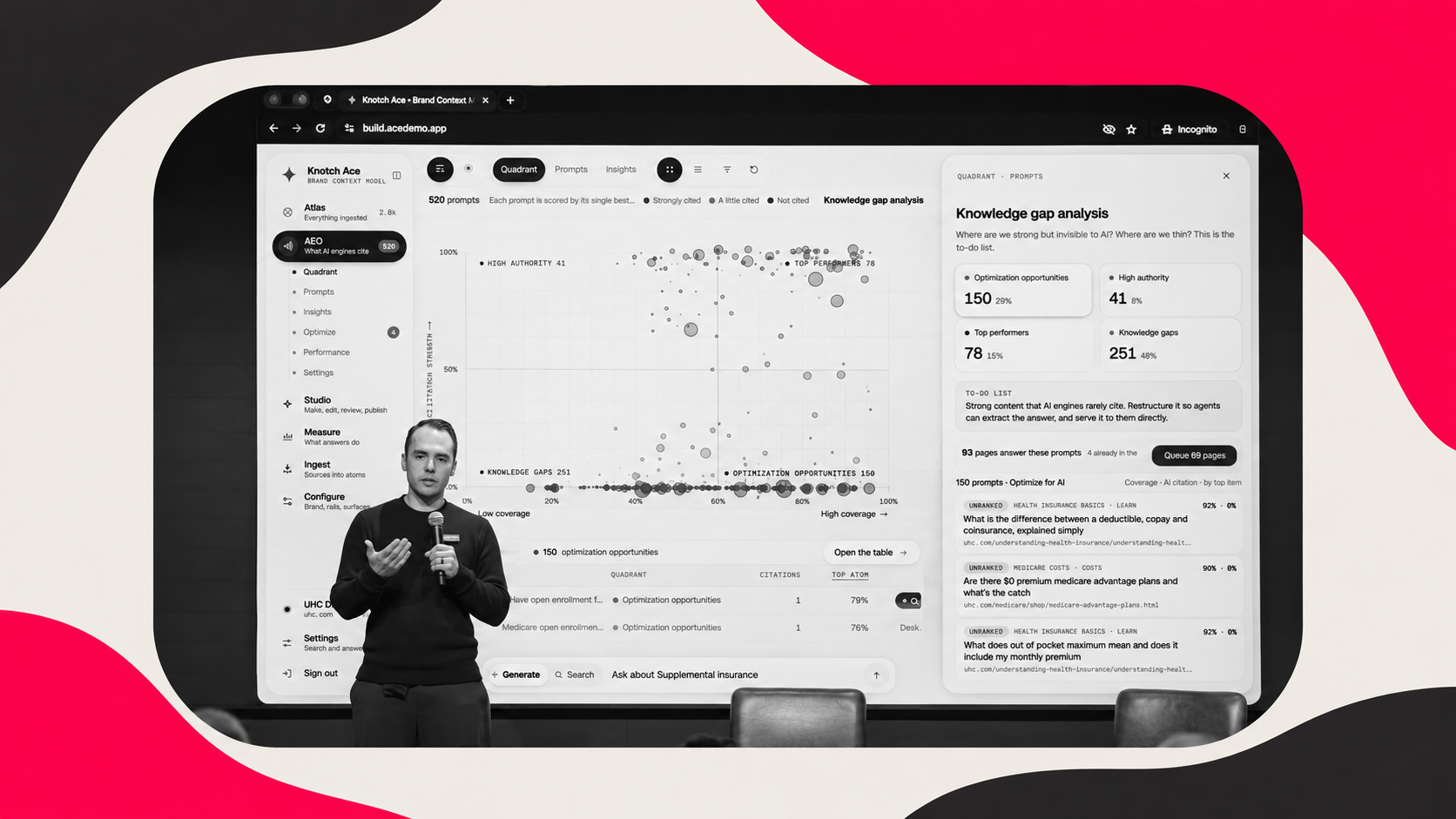
Every marketing leader I talk to has heard some version of the same question from their CEO: why doesn't ChatGPT say the right things about us?
The industry's answer so far has been to invest in some monitoring tools – which might not necessarily line up with what other monitoring tools say – and to create a broad to-do list. Track your visibility score. Write more pages. Add more FAQs. Patch the website and hope the AI notices.
We think that's solving the right problem, but it’s working within the context of the digital age, not the AI age. And that means it's slow to implement and changes made are likely to be out of date within months. That’s why today, Knotch is launching Ace for Agents, a new expansion of our Ace AI-native infrastructure. Ace for Agents makes a brand's existing content accessible, understandable and citable for AI search and personal agents. And it does this without rebuilding your website or changing the experience for human visitors.
From the digital age to the AI age
For decades, the web’s building blocks have been pages, URLs, templates and sitemaps. That structure was designed for two audiences: people who browse, and the search engines that index and rank pages for them. It has never worked perfectly. Think about the last time you landed on a page that was very obviously written for search engines, not humans. It may have been stuffed full of keywords or generic explanatory text to the point that it was nearly unreadable – and this may have made a negative impact on your impression of the brand.
Today, brands serve a third audience – and it’s a completely different one. LLMs like ChatGPT, Claude, Gemini, and Perplexity, as well as the personal agents acting on people's behalf, don't care about your page layout. They're looking for knowledge. They want precise facts, verified claims, and answers they can find, trust and cite.
As our co-founder and CEO Anda Gansca puts it: "The digital-native era was built on pages, structure, and templates. The AI-native era is built on data, context, and experience. Brands now need to serve people, and the AI agents acting on their behalf. Both need the brand's knowledge, not its page layout."
That transformation from content to knowledge is the idea at the center of everything we've built with Ace.
Atoms, not pages
Ace starts by building what we call a brand context model. This is an AI-native version of the brand, created from the content a company already has and ingested from wherever it lives.
This can include the brand’s domains and subdomains, images, offline documents, even partner and affiliate sites. Where a brand already has systems of record – like a CMS, DAM, PIM, document management system or content services platform – Ace can connect to them directly and bring over their tags and rules along with the content.
Then it breaks that content down into atoms.
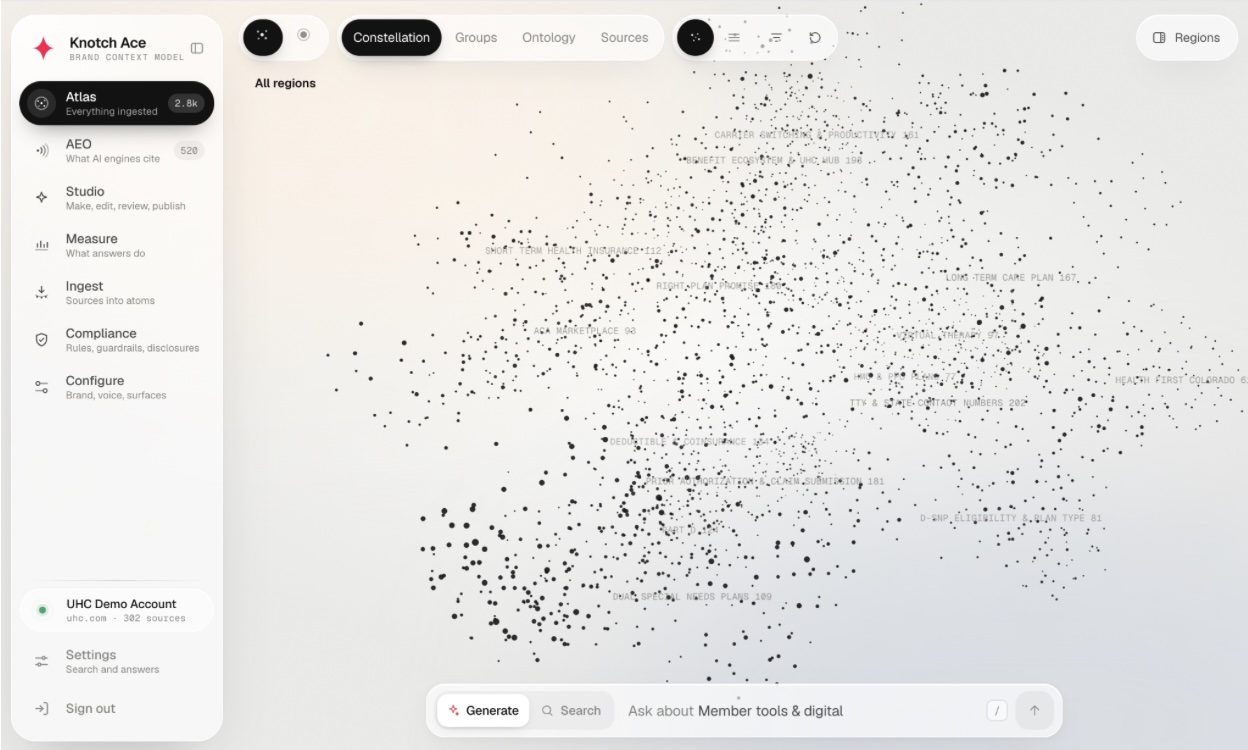
An atom is a single piece of knowledge – a fact, claim, or key idea – that can stand on its own and still answer a question. A page might hold dozens of them, but they’re often buried among navigation, layout, and copy written for search rankings. That’s why when Ace creates an atom, it’s enriched with the context it needs to be useful in isolation. Each atom keeps its source and is tagged by topic, audience, funnel stage and intent, so the right knowledge can be found quickly and precisely.
Pages are how you rank, but atoms are how you answer. LLMs care much less about every paragraph on your page (or, in contrast to many SEO tactics, how frequently a fact or concept is mentioned) than about one thing: do you have the answer to the question being asked? And because they live in one brand context model, the same knowledge that powers what agents see can power the experiences you build for people. Both audiences are drawing from a single source of truth.
How Ace for Agents works
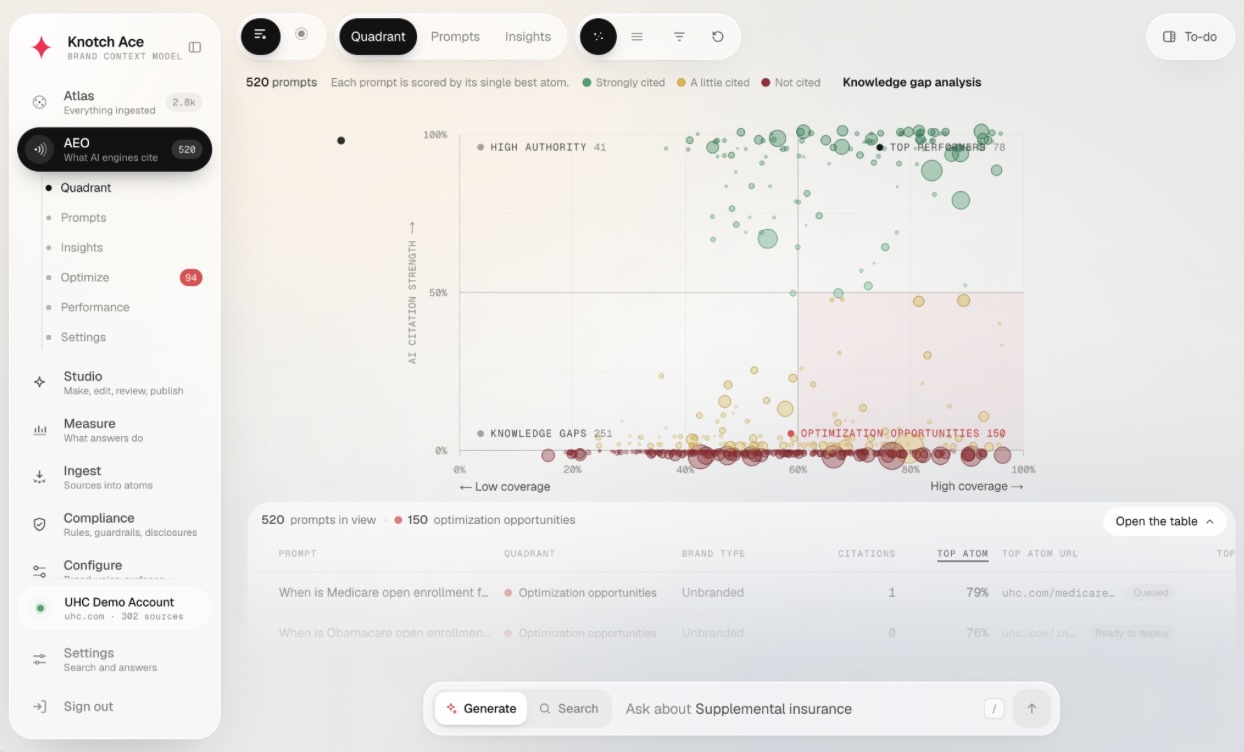
1. It finds the gaps. Ace generates the questions your audiences are asking, or uses the prompts you already track in LLM visibility tools and run them against your brand context model and across the major LLMs. This creates a matrix of knowledge against citations. It shows where you have the answer and are being cited, where you have the answer but AI isn't citing you, and where the knowledge simply doesn't exist yet. That turns a vague visibility score into a prescription: optimize what you have, or create what's missing.
2. It optimizes the content. For pages where you already have an answer, Ace enriches what agents receive: concise summaries, FAQs, image descriptions, structured data and a lean, knowledge-first version of the page, stripped of the layout and navigation agents don't need. This matters more than most teams realize. Since many LLM crawlers don't execute JavaScript, content behind buttons, tabs or client-side rendering can be invisible to them even when it's sitting right there for humans. You stay in the loop for the whole process. Every optimization and every new piece of knowledge can be reviewed and approved before it reaches an agent.
3. Serve it at the edge. The optimized version of your site is delivered to verified AI agents through your CDN, but your human visitors see exactly the same site they always have. Ace creates a true dual-surface website: one experience designed for people, and one designed for the machines working on their behalf. It also accounts for how different engines behave. Google, for instance, prefers that what agents see matches what humans do, so Ace supports CMS-level updates there as well.
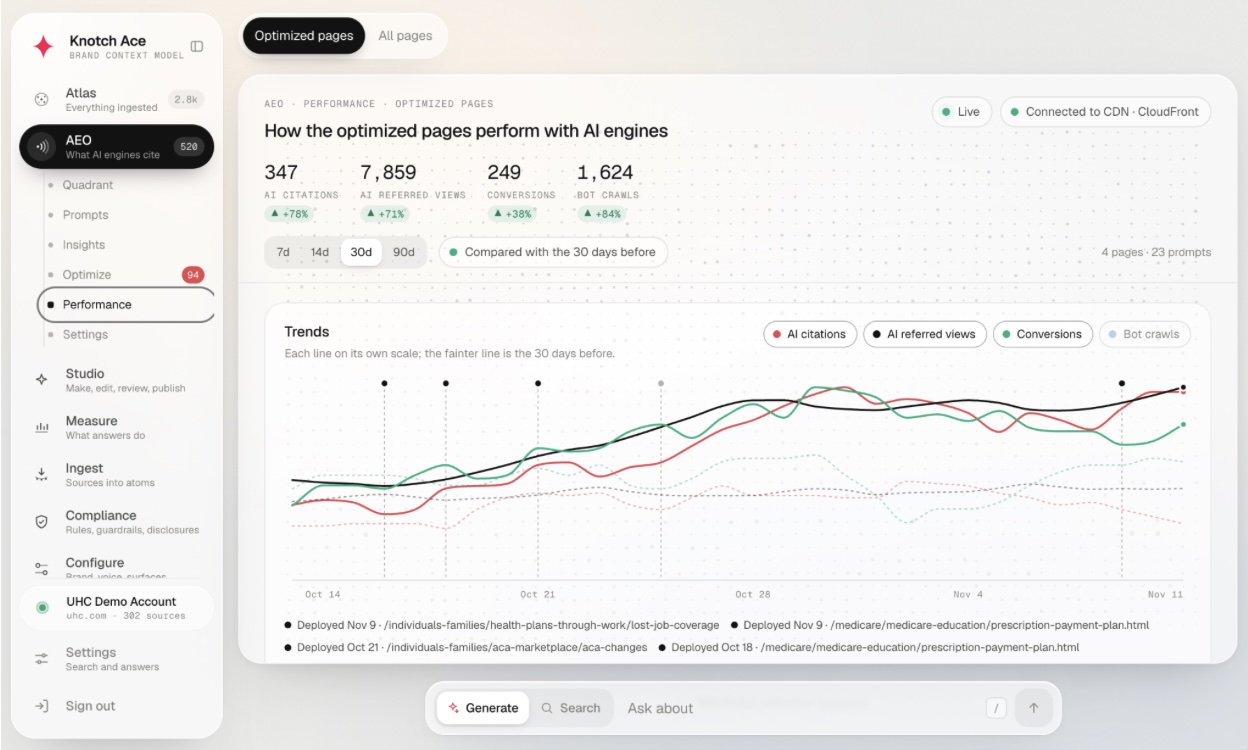
4. It helps you prove the lift. Ace tracks citations, AI-referred traffic and agent crawl activity before and after its implementation, so you can show leadership what changed. And because it detects changes to your source pages, agent-facing content stays current as your site evolves.
Built to evolve
The truth about AI visibility is that what works today may not work in three months, and nobody has a crystal ball. LLMs are constantly changing how they absorb information and cite. Meanwhile, personal agents are starting to act on customers' behalf and new protocols on the horizon like MCP and A2A are changing how agents connect to brands.
That's exactly why we built Ace the way we did. In the digital era, brands invested in software, built on it, and then watched it go stale. They’d have to start a five-year rip-and-replace cycle all over again to fix it. That pace can't keep up with the AI era.
Ace is AI-native by design. Once your knowledge lives in a normalized brand context model, the surface it's delivered to matters much less. When a new kind of agent, protocol or device comes along, Ace will assemble the right answer in the right format from the same source of truth. You won’t need to start over.
That's what AI-native infrastructure means to us. It’s a system that evolves alongside human behavior, LLM behavior, and agent behavior – instead of locking you into today's version of the web.
We’re excited to show you how this works. Let us know if you’d like to learn more.
Further Reading:
Published on November 17, 2026
Become a thought leader
Become a thought leader





Trusted by the largest (and now smartest) brands in the world.
“Before Knotch we did not understand what content was driving business results. Now we understand which content moves the needle. Knotch’s cohesive reporting and insights paint a real picture of what’s happening on our website instead of the patchwork quilt that comes from a Google Analytics approach. With Knotch we have been able to re-prioritize ad spend, route better leads to our SDR team, and inform our content development initiatives.”

"The Knotch platform ensures that we deliver high-performing content tailored to young home shoppers, enhancing their experience and driving better business outcomes.”

"Our partnership with Knotch has been highly successful, empowering us to leverage data-driven insights and refine our content strategy.”
