
Key Takeaways: Found By AI, Chosen By People

When your next customer ultimately finds you, they may have begun their research in a chat window, formed a shortlist without visiting your website, and arrived already knowing the basics.
At that point, what should your content be doing?
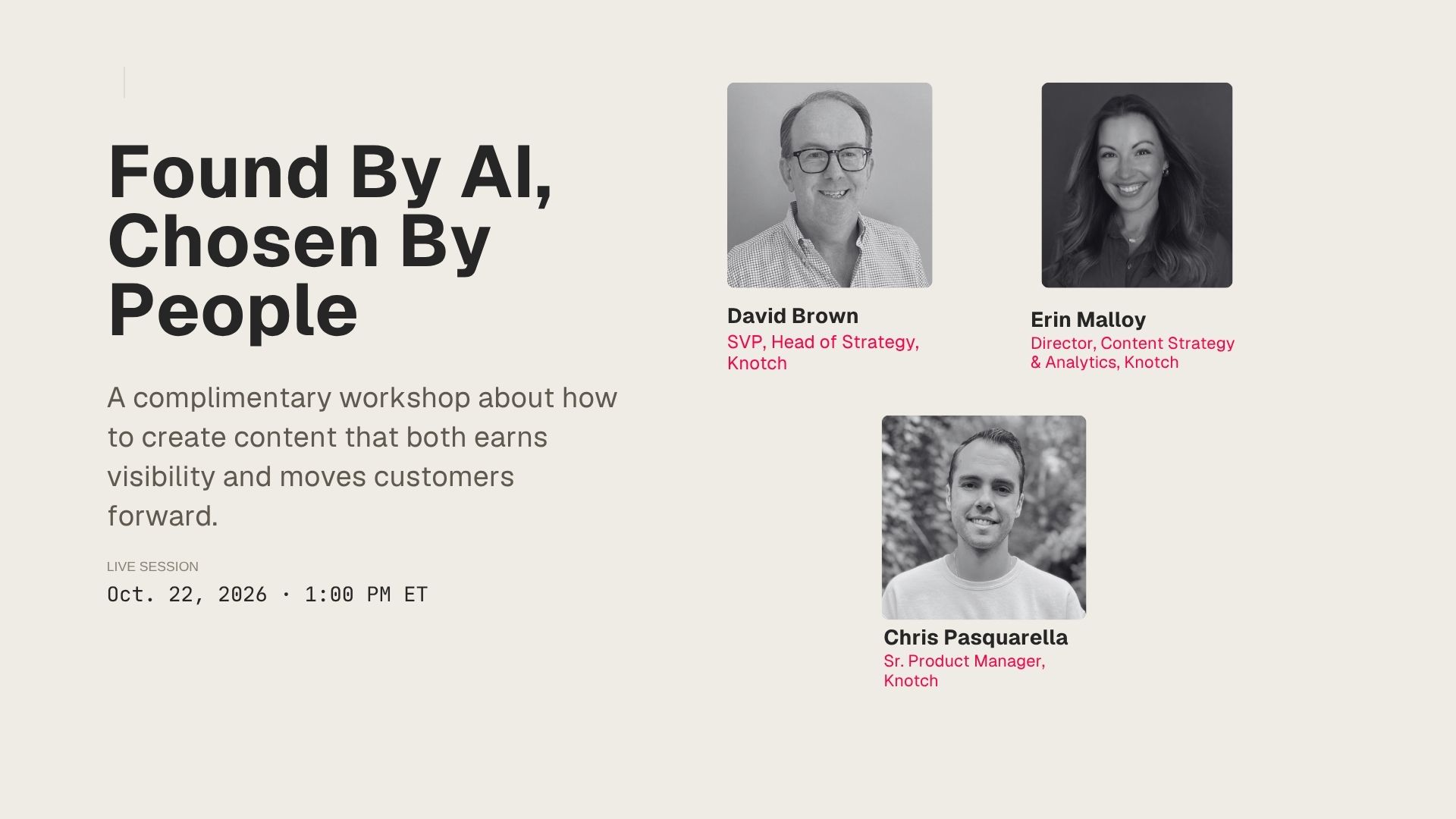
That question was the catalyst for Knotch’s latest workshop, “Found by AI, Chosen by People: Creating Content that Earns Visibility and Moves Customers Forward.” Drawing on Knotch Labs research and our work with clients, team members David Brown, Erin Malloy, and Chris Pasquarella explored how AI is changing discovery, what makes content useful to agents and people, and how brands can connect visibility to business outcomes.
These new audience journeys are complicated. But there’s an easy starting point for brands: Make your expertise accessible, answer questions clearly, and give visitors a compelling reason to take a clear next step.
1. AI’s influence on the journey is much bigger than its referral traffic
If you look only at direct referrals, AI can seem like a small part of your audience’s journey. Knotch Labs research puts direct LLM referrals at roughly 0.1% to 0.4% of website traffic in the data discussed. But someone who does their research in an AI tool may ultimately wind up your site not by clicking on an LLM citation but through search, a direct visit, or another channel.
To understand that influence, Knotch asked visitors to clients’ sites a question through on-site surveys: Had they used an AI tool to research the topic before arriving?
Across more than 30,000 responses collected over roughly a year and a half, 22% of respondents on average reported AI influence. These are self-reported findings from participating audiences, but they reveal a part of discovery that referral analytics alone can miss. Much of AI-influenced traffic is hidden.
Those visitors may also have different needs. As Erin Malloy explained, “They’re coming to your site to either validate what they learned or learn more.”
The takeaway: Measure direct AI referrals alongside self-reported AI influence, then examine what those visitors need when they arrive. Content that repeats their initial research may fall short of helping them make a decision.
2. Make sure agents can access the expertise your human visitors can see
A page that looks complete to a person may look very different to an AI crawler.
Chris Pasquarella described how important information can be difficult for agents to retrieve if it depends on JavaScript rendering or sits inside images and PDFs. A chart may communicate a finding beautifully to a human reader while leaving its underlying data difficult for an agent to extract.
The first step is to inspect what relevant crawlers actually receive. Can they retrieve the core information? Are important findings available in text? Is the content structured clearly enough to understand and use?
FAQs, concise summaries, and key takeaways can help make information easier to find. But accessibility also requires collaboration with technical teams, including reviewing activity at the content delivery network (CDN) layer.
There’s also a difference between a citation, where an AI answer links to your content as a source, and a mention, where your brand appears without necessarily receiving a link. Both are useful to monitor.
The takeaway: Audit the accessibility of your existing expertise in text before assuming you need more content. Give priority to important information that people can see but relevant agents may struggle to retrieve.
3. Clear structure gets your content understood. A distinct perspective gives it value.
Adding summaries and FAQs is a useful practice. It doesn’t guarantee that a brand will stand out when competitors follow the same blueprint.
Erin Malloy offered a more demanding test: “What can we say as a brand that’s truly distinct?”
That might be proprietary research, an expert’s interpretation, or a point of view grounded in brand experience. Both people and AI systems should have something they can strongly associate with your brand.
David Brown challenged brands to apply that test before publishing: does the content express a distinct perspective, or does it simply cover a categorical need others have already covered?
Maintaining that distinction also means preserving a human voice. Content strategists can use introductions, transitions, and endings to bring personality and perspective into a piece, while keeping summaries and explanatory sections concise and clear. Brown recommended interviewing subject matter experts and then having skilled writers shape their insights into accessible content.
The takeaway: Make clarity and distinctiveness part of the same editorial brief. Ask what the audience will learn from your brand that they would struggle to find elsewhere.
4. Answer the question quickly, then help people find their next one
David Brown’s advice on content structure was direct: “Answer their bloody question.”
Don’t make someone watch two minutes of video or read a thousand words to reach the information they came for. One of Knotch’s financial services clients found that the pages rated by audiences as most informative were those that answered each section’s question in their first sentence, then supplied the detail.
But answering the immediate question is only part of the opportunity.
Knotch conducted a study of roughly 10,000 B2B and B2C pages, using a minimum threshold of 1,000 views. Nearly half of the high-traffic pages had exit rates above 95%. That means visitors were leaving them without ever clicking to another page on the site. True, some visitors may have left satisfied; nevertheless, those pages represent a substantial opportunity to support further exploration.
On the other hand, the pages with strong recirculation (the rates of visitors clicking to another page from them) shared one key commonality: they anticipated the reader’s next question and offered a specific path to answer it, often at the moment that question would arise within the article.
The takeaway: Review your most-visited educational content. Answer its central question promptly, then identify the natural follow-up question and provide a useful next step. Let readers choose how deeply to explore.
5. A softer CTA can support stronger downstream results
An educational article and a product decision page have different jobs. Their calls to action should reflect that.
Erin Malloy described three levels of CTA relevance: a generic action used across the site, an action tailored to a topic or category, and an action tailored to the reader’s likely next question. The third has produced the strongest results in her work.
For someone reading about loans, that question might be whether they can afford the monthly payment. A payment calculator provides a useful bridge: visitors can explore their own situation before deciding whether to contact the brand.
Malloy described a client test in which replacing hard-sell CTAs with softer next steps increased downstream qualified leads. The approach is now being expanded across more than a thousand articles.
As David Brown put it, “Don’t ask for the conversion, ask for the next question.”
The takeaway: Match the CTA to the page’s role and the visitor’s readiness. Evaluate the downstream result, including qualified leads, rather than judging success solely by immediate conversion clicks.
6. Measure the connection between visibility, progression, and conversion
The team’s measurement advice connected three questions: can AI find your content, are people discovering your brand, and what happens when they reach your site?
Chris Pasquarella recommended monitoring relevant crawler activity alongside citations, mentions, and competitive share of visibility. Prompt tracking can offer directional insight, but a selected prompt set is a sample of possible questions. Keep it focused on the topics your brand needs to answer, and interpret changes in competitive context.
Erin Malloy emphasized recirculation: whether visitors continue to another page. Establish a baseline by referral source, because visitors arriving through email, search, and LLMs may behave differently. Then examine how that progression relates to conversion.
The takeaway: Connect discovery metrics to audience behavior and business results. Being found creates an opportunity; the next experience determines how well your brand uses it.
Conclusion: Put the next question at the center of your content strategy
The workshop left its audience with a straightforward place to begin: review an important page, check whether agents can access its expertise, make its answer clear, and improve the path to the audience’s next question.
Those changes bring discovery and performance into the same conversation. Plus, they’ll help your content earn its place at more than one stage of the journey.
Published on October 26, 2026
Become a thought leader
Become a thought leader







Trusted by the largest (and now smartest) brands in the world.
“Before Knotch we did not understand what content was driving business results. Now we understand which content moves the needle. Knotch’s cohesive reporting and insights paint a real picture of what’s happening on our website instead of the patchwork quilt that comes from a Google Analytics approach. With Knotch we have been able to re-prioritize ad spend, route better leads to our SDR team, and inform our content development initiatives.”

"The Knotch platform ensures that we deliver high-performing content tailored to young home shoppers, enhancing their experience and driving better business outcomes.”

"Our partnership with Knotch has been highly successful, empowering us to leverage data-driven insights and refine our content strategy.”
