
Why your highest-traffic articles might be dead ends

The best content on your website doesn’t just answer a user’s question — it opens the door for them to discover more. Still, most content reporting starts with traffic, and that’s where the trouble hides: The pages that look strongest in a quarterly review are often the same pages where readers leave your website. When we started seeing this in Knotch’s analytics, we got curious.
We wanted to know how often that happens, whether it corrects itself, and what distinguishes the articles that do send readers onward. So, we looked at nearly 10,000 article pages across B2B and B2C brands over six quarters. The median high-traffic article ends 94% of the visits that reach it — in other words, a seemingly successful article in terms of traffic is actually ending visitors’ journeys without a conversion more than nine out of ten times.
Meanwhile, the articles that break this pattern aren’t the longest, the best linked, or the ones with the strongest calls to action. So — what are they, and how can you ensure you’re creating more of them?
Key takeaways
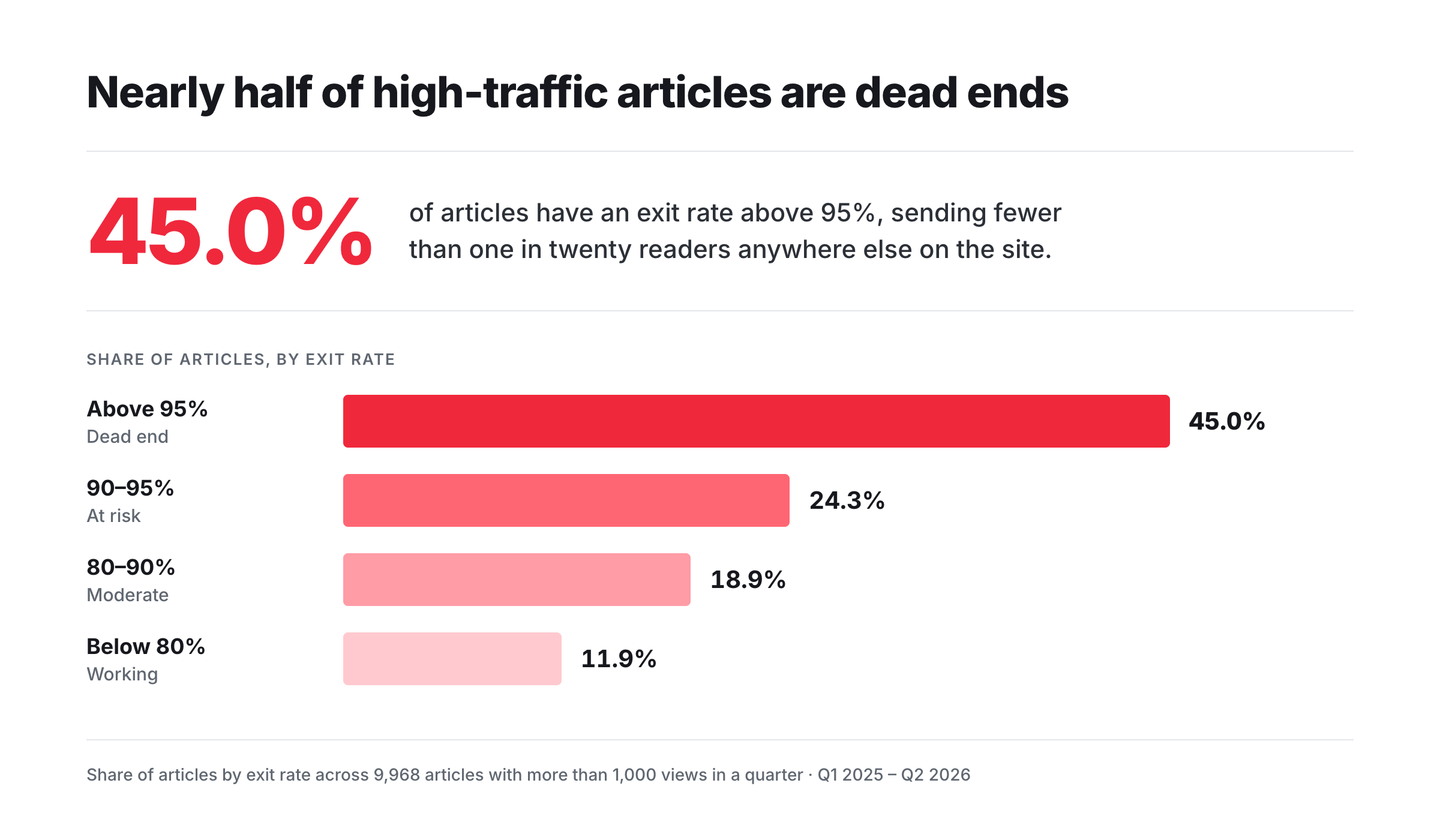
- The median high-traffic article (more than 1,000 views in a quarter) ends 94% of the visits that reach it. 45% are dead ends — an exit rate above 95%.
- Dead ends persist. 80% of pages are still dead ends a quarter later, against 11% of healthy articles that become one. Over a year, 71% stay dead ends.
- Traffic, time on page, and the structure of the page do not explain which articles send readers onward. More traffic tends to mean less progression, not more.
- What separates high-recirculating articles from dead ends is the question the article answers. Articles built around a settled question sends fewer readers onward than ones that hand the reader their next question.
What counts as a dead end?
A dead end is an article where more than 95% of visits end with that page. Those visitors neither convert from that page, nor do they click through to any other pages on your site. Where exactly you draw that line matters less than you’d expect, because most of the articles we analyzed have exit rates somewhere in the 90s either way. Move the line to 90%, and the story barely changes.
Every platform defines these metrics a little differently. At Knotch, exit rate is the share of visits to a page that end there, not counting visits that ended in a conversion — a page that finishes the job isn’t penalized for being the last one someone saw. Recirculation rate is the share of visits where the reader continues to another page on your site, and it’s the strongest predictor of conversion we’ve found — ahead of scroll depth, time on page, and traffic — as we covered earlier this year.
How many high-traffic articles are dead ends?
Most high-traffic articles are dead ends, or close to it. 45% have an exit rate above 95%, and another 24% sit between 90% and 95%. Fewer than one in three fall below 90%, and the median exit rate is 94%.
These aren't obscure pages. They're the ones that look healthiest in a traffic report: They’re cited in quarterly reviews and held up as the pieces to make more of. An article can be one of the most-visited pieces a brand publishes all year and still send almost no one onward.
Do dead ends recover on their own?
The data shows that dead ends rarely recover. Of the articles that were dead ends in one quarter, 80% were still dead ends three months later. Going the other way, only about one in ten articles that were performing well became a dead end over the same period — so this is a condition that sticks far more often than it develops. Stretch the window to a full year, and roughly seven in ten dead ends are still dead ends.
Seasonality is the obvious objection, and a fair one. Some content may be technically evergreen year-to-year, but only relevant at a particular time of year (say, holiday shopping). So we also compared each dead end with itself a full year later, in the same season, when any seasonal dip should have reversed. Most hadn’t budged. A dead end is usually a property of the page, not a consequence of a bad quarter.
What do high-recirculating articles do differently?
They answer a question the reader is still asking.
Articles that answer a settled question tend to end that visit. The reader came for a fact, got it, and left satisfied. They’re perhaps looking for a definition, a number, or how two named options compare. Articles that answer an open question, on the other hand, give the reader their next question and the site is there to answer it on another page. For example: Which option should I pick? Am I ready to purchase? How do I decide?
In 16 of the 19 content sections we tested (a section being a brand's blog, its learning center, or a topic category within one of those), pages built around a settled question sent fewer readers onward than the typical page beside them in that same section.
You can see just how big this difference is when you pair two articles side-by-side. On one site, two articles ran in the same section, using the same template, and were of similar lengths. One answered what a particular product is — a definition, complete on the page, with nothing left for the reader to decide — and recirculated 2.8% of readers. The other walked through how to choose the right product for a particular buyer, where the answer depends on what their needs are. That article recirculated 25.7%. On another site, an article comparing two options head-to-head sent 1.2% of readers onward. An article on the same shelf that helped readers decide which option suits which situation recirculated 34.5%. The subject matter was the same, but one article closed the question and the other opened the next one.
These comparison articles are the telling case. They look like content that’s spurring a user to make a decision and continue their journey forward, but most lay out the differences and stop there — leaving the reader to make the call alone. The comparisons that recirculate go a step further and say which option suits which situation.
You might expect traffic to explain which articles become dead ends, but paradoxically, it points the other way. Views and recirculation move in opposite directions in 21 of the 25 sections we tested, time on page shows no relationship at all, and topic explains about a sixth of the variation within a single brand’s library. And in the matched pairs, the in-body links, related content modules, calls to action, and length usually matched on both sides.
The good news is that this fix rarely requires a rebuild. Usually it means adding a closing section to the article that names the decision the reader now faces and points to the page that helps with it.
Why it’s worth optimizing for recirculation
There’s another reason to care about which questions your article answers. The ones that end visits — what something is, what the current figure is, how two options compare — are pages that are answering the same questions AI-generated answers increasingly handle before anyone reaches a website. That isn’t something this analysis measured, but the direction seems clear. As AI absorbs the settled questions, the pages left to compete for are the ones built around open questions, which conveniently are also the articles that send readers somewhere next.
That’s what recirculation measures. Of every engagement metric we have tested, recirculation rate is the one that shows a consistent relationship with conversion — which is what makes a dead end worth fixing rather than just worth noting. Improving it starts with a question any writer can answer without opening a dashboard: When someone finishes this page, what do they want to know next? Answer that on the page, and the reader keeps moving.
Where should you start?
- Find the articles that are both heavily visited and also have an exit rate above 95%. These are the ones with more to gain.
- For each article, take note of the question it answers, then answer what the reader would want to know next on their journey to consideration and intent. If you can’t name the next question, the article may simply be complete — it might need a companion piece rather than a fix.
- If you can name that next question, check whether the page takes the reader to it — not a generic related-content module or a contact-us button, but a specific next step that answers the question this article just raised.
Frequently asked questions
What is a good exit rate for an article?
The median high-traffic article sits at 94%, so anything below 90% is already in the better half. Treat above 95% as a dead end, 90–95% as at risk, below 90% as moderate, and below 80% as working.
What's the difference between exit rate and bounce rate?
Bounce rate counts visits that start and end on the same page. Exit rate counts every visit that ends on a page, however the reader got there. At Knotch, exit rate also excludes visits that ended in a conversion, so a page that finishes the job isn't penalized for being the last one someone saw.
Will adding more internal links lower an article's exit rate?
Usually not on its own. When we compared matched pairs of articles with sharply different recirculation, both sides almost always had in-body links. Their calls to action, related-content modules and length usually matched too. What separated them was the question the article answered. A link helps when it points to the specific next question the reader now has, not when it's one more option in a related-articles list.
Is time on page a good sign that an article is working?
Not for moving readers forward. Time on page showed no relationship with recirculation in our analysis. Of every engagement metric we've tested, recirculation rate is the one with a consistent relationship to conversion.
Is a high exit rate always bad?
No. If an article answers a genuinely final question, a high exit rate may just mean it did its job, and it may need a companion piece rather than a fix. The pages worth rewriting are the ones where the reader is mid-decision and the article stops short. Those rarely improve on their own: 80% of dead ends were still dead ends a quarter later.
Published on September 30, 2026
Become a thought leader
Become a thought leader








Trusted by the largest (and now smartest) brands in the world.
“Before Knotch we did not understand what content was driving business results. Now we understand which content moves the needle. Knotch’s cohesive reporting and insights paint a real picture of what’s happening on our website instead of the patchwork quilt that comes from a Google Analytics approach. With Knotch we have been able to re-prioritize ad spend, route better leads to our SDR team, and inform our content development initiatives.”

"The Knotch platform ensures that we deliver high-performing content tailored to young home shoppers, enhancing their experience and driving better business outcomes.”

"Our partnership with Knotch has been highly successful, empowering us to leverage data-driven insights and refine our content strategy.”
