
Key Takeaways: Taking Personalization From Ambition to Action

With the rise of generative AI, personalization in marketing has gone from a long-shot “what if” to a key roadmap item. And marketers seem to be in agreement: A year ago, Forrester Research’s CMO Pulse Survey report revealed that 88% of marketers said delivering high-quality personalized experiences to their customers was important to their work.
Getting a personalization initiative funded and backed by leadership is still challenging, but it’s more possible than ever. And that’s when the real work starts. You may have been able to prove to leadership that there’s a real case for its impact on business outcomes, but you still have to decide where to start, what to measure, who needs to be involved, and how to turn a successful test into a keystone of your marketing initiatives.
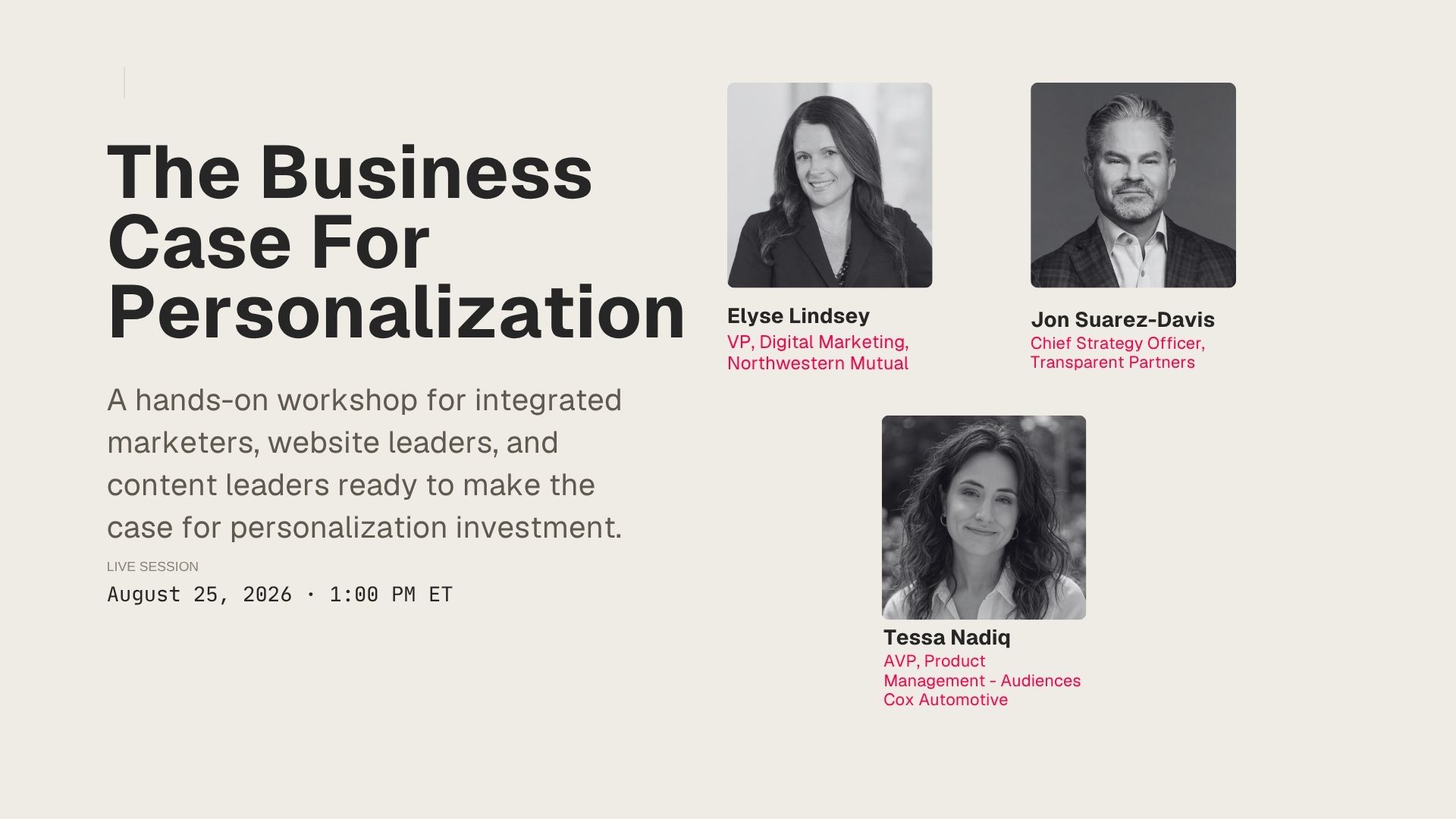
That was the focus of Knotch’s latest workshop, “From Ambition to Action: Making Personalization Work.” David Brown, Knotch’s SVP of Strategy, spoke with Melissa Bouma, Chief Growth Officer at Manifest; Marci Raible, former VP of Media Strategy and Digital Growth at The Campbell’s Company; and Mike Snead, Director of Knowledge Strategy for Zillow’s customer experience group.
When you design a personalization pilot, you’re looking to answer a business decision – not just to demonstrate that personalization is possible. Here are the workshop’s learnings for teams that want to make sure they do just that.
1. Pick one customer moment and one behavior to change.
Personalization can span channels, audiences, and journey stages. Trying to address all of them in a first pilot makes it difficult to tell what worked.
Melissa Bouma recommended starting with a specific point of friction: Where are customers dropping off or getting stuck? What context would help them move forward? What behavior should change as a result? When you align stakeholders on that outcome before the pilot begins, you can ensure that a focused test won’t inadvertently become responsible for every goal across marketing, sales and product.
Mike Snead offered a useful way to narrow the scope: Choose one audience, one moment, and one decision to improve. A strong first use case has a clear customer need, enough context to respond meaningfully, content the team trusts, and a way to measure whether the experience helped. A promising idea may belong on the roadmap rather than in the first pilot if its content or integrations are not yet ready.
2. Design each test to answer a specific question.
Marci Raible described how a Campbell’s Soup weather-based effort began with a simple hypothesis: Would messaging tied to incoming cold weather drive more traffic? Later iterations accounted for the fact that “cold” means something different in Los Angeles than it does in Chicago, and then explored regional differences in recipe preferences.
Each step gave the team something distinct to learn. That matters because, as Raible recounted, seeing the possibilities in the data can overcomplicate a team’s first test very quickly. A pilot doesn’t need to prove the entire personalization strategy; rather, it needs to establish whether a particular use of context creates value and what to try next.
Inconclusive or unsuccessful tests can also be useful. Raible recalled work at Bank of America in which personalization hit a ceiling – at a certain point, additional variation stopped producing lift. Knowing where the returns level off can help a team decide how much complexity is justified.
3. Set the success threshold using lift, cost, and risk.
Personalization has a price tag beyond the technology itself. Teams may face higher media costs, additional production work, or the expense of operating AI tools (which often prove to be more expensive than marketers anticipated). Marci Raible advised estimating those inputs early and identifying the lift required to make the effort worthwhile. The pilot can then test the assumptions behind that forecast.
The panel also discussed how to limit exposure while learning. A controlled landing page may make sense when the team needs to isolate an experience and its effects. Testing within a particular traffic source may be more useful when the source itself is part of the problem. For a higher-risk experience, like an AI agent that actively guides visitors around a site, Mike Snead suggested starting with a small share of the audience and watching both direct feedback and baseline site metrics before expanding.
An early, measurable win can help earn support for more ambitious work. Knotch’s David Brown cautioned that a long preparation period with nothing in-market can erode leadership’s confidence while costs continue to rise.
4. Plan for what happens after the pilot.
A successful pilot is a beginning, not an operating model. Melissa Bouma recommended examining specifically why it worked, then testing whether the same insight applies to an adjacent audience, journey moment, or content opportunity.
Making the experience ongoing also changes the resource question. Mike Snead noted that a small team assembled for a short test may need dedicated people and repeatable processes to sustain the work. Marci Raible added that leaders may reasonably ask what the program will cost if it succeeds. Thinking through that question early makes it easier to move from a temporary experiment to a lasting capability.
The right team extends beyond the people who launch the test. Analytics and data science can provide an objective view of results. Marketing technology and insights teams can help carry learnings across the organization. Snead also pointed to customer service conversations as a source of feedback: questions people ask in support can reveal where content or product experiences should improve before a customer needs help.
5. Set brand boundaries before creating variations.
Personalization doesn’t mean creating a different brand for every audience – if it does, it can potentially put the brand value at risk. Part of a brand’s strength comes from consumers’ ability to relate to it in interactions with one another, and if personalization has gotten so extensive that two customers are experiencing two completely different brands, that’s a problem. The brand has to stay recognizable while behaving appropriately in different contexts.
Raible recommended defining the brand elements that must remain fixed and distinguishing them from the areas where teams have room to adapt. Brand colors and fonts may be non-negotiable; voice and tone may have some flexibility (say, some subtle changes if the customer is Gen-X versus Gen-Z) while still needing parameters to ensure it feels familiar. Making those decisions upfront is far easier than debating them during every execution.
This becomes more important as AI makes content versioning less costly. Bouma described an approach in which creative talent develops original brand content and AI helps adapt its format and copy. Snead argued that the challenge is increasingly about context: Everyone on a team needs to know how their brand should behave at each touchpoint while preserving its standards for tone, accuracy, and customer protection.
6. Treat personalization as a shared capability.
No single job title owns all the skills required. Snead emphasized information architecture: content needs structure and metadata that connect it to customer needs and journey moments. Raible called for a more consistent audience data strategy across departments so different teams are working with compatible views of the customer without requiring constant check-ins. Bouma highlighted the need for brands to hire someone curious enough to turn data into hypotheses and decide what to test next.
Knotch’s David Brown added a complementary role: A strong program manager who can bring those specialists together, maintain alignment, and keep the work moving.
The path forward requires both focused effort and collaborative approaches: Start with a customer moment that the team understands, define its ideal outcome, involve the people who can deliver and measure it, and use each test to build the foundation for the next.
Your first personalization pilot should leave the team with more than a lift number: It should tell you whether the customer response is valuable, whether the economics work, and what must be in place to repeat it.
Published on September 29, 2026
Become a thought leader
Become a thought leader






Trusted by the largest (and now smartest) brands in the world.
“Before Knotch we did not understand what content was driving business results. Now we understand which content moves the needle. Knotch’s cohesive reporting and insights paint a real picture of what’s happening on our website instead of the patchwork quilt that comes from a Google Analytics approach. With Knotch we have been able to re-prioritize ad spend, route better leads to our SDR team, and inform our content development initiatives.”

"The Knotch platform ensures that we deliver high-performing content tailored to young home shoppers, enhancing their experience and driving better business outcomes.”

"Our partnership with Knotch has been highly successful, empowering us to leverage data-driven insights and refine our content strategy.”
