
Key Takeaways: The Business Case For Personalization

Personalization succeeds when it creates measurable relevance, not when it just adds more technology.
The ability to personalize digital experiences for consumers has been one of marketing’s top prizes for years. AI has finally enabled it to live up to its promises, but marketers are now facing a different roadblock: Getting company buy-in and budget.
Earlier this year, research from Gartner found that 56% of CMOs attested to lacking the budget to fully execute their 2026 AI strategy. And, unfortunately, this is why so many personalization efforts are struggling to get off the ground. C-suites want to hear about results rather than fear they’re throwing money at something that turns out to be ineffective or a money pit.
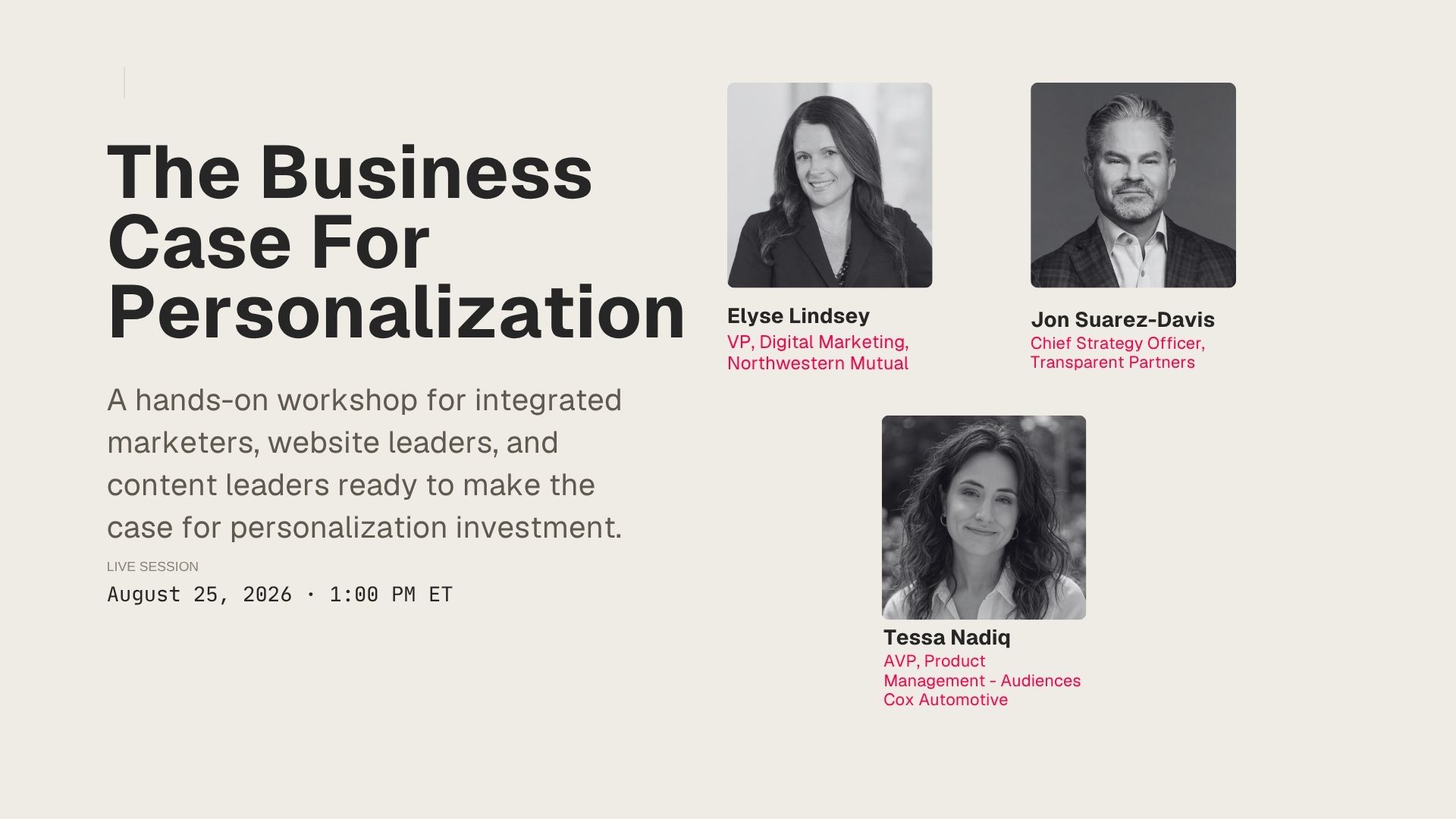
Creating a strategy for addressing those challenges was at the core of Knotch’s recent workshop, “The Business Case for Personalization,” hosted by David Brown, SVP of Strategy at Knotch. He was joined by:
- Tessa Nadiq, AVP of Product Management for Audiences at Cox Automotive
- Elyse Lindsey, VP of Digital Marketing at Northwestern Mutual
- Jon Suarez-Davis, Chief Strategy Officer at Transparent Partners
Here are six concrete lessons that marketers can apply as they build (or rebuild) their approach to personalization.
1. Sell a business outcome, not a personalization program
Personalization is a capability, not an outcome. That distinction is crucial when competing for funding. A proposal framed around identity resolution, data architecture, or a personalized customer journey may appeal to marketers, but it’s less likely to persuade a CFO deciding among dozens of potential investments.
Instead, begin with an outcome the business already values: higher conversion, lower acquisition or operating costs, fewer abandoned journeys, greater retention. Even pointing to the potential for reduced demand on call centers or customer service departments could be something stakeholders would latch onto.
Elyse Lindsey recommended leading with the value at stake and then explaining the underlying math. Beginning with an engagement metric and slowly working toward its financial relevance risks losing an executive audience before reaching the conclusion.
“If you start with the value and the outcome and then explain the math and how you got there, you have their attention,” she said.
The ultimate lesson: Write the financial headline first. Then show how marketing’s leading indicators connect to it.
2. Use the first win to help fund the longer-term vision
Tessa Nadiq described a familiar failure pattern: An ambitious personalization program gets off the ground, but then dies a slow death as resources are gradually cut and new requests denied.
Building an identity layer, connecting systems, and establishing the necessary data infrastructure can take as long as a year. During that period, the initiative may show little visible customer impact. When budgets tighten, a program that seems to be a cost center rather than a profit generator becomes vulnerable even if everyone still supports the vision.
“To do it right, you may have to build the identity layer and complete six to 12 months of foundational work,” Nadiq explained. “But there’s no consumer-facing story while you’re progressing through that; it shows up as a zero on the dashboard. The initiative is approved in principle, but starved in practice, because work that isn’t yet delivering visible value is often the first to land on the chopping block.”
Marketers need to avoid treating near-term value and long-term transformation as separate requests. Consider starting with a limited early use case for personalization, like:
- Re-engaging customers who abandon a high-intent journey
- Aligning a landing page with the ad or search term that brought a visitor there
- Prepopulating information a customer has already provided
- Adapting an offer or next step to recently observed behavior
- Personalizing follow-up through an existing email or messaging platform
These won’t be full deployments of a personalization strategy, and they shouldn’t be considered as such. The goal here is to establish enough value and organizational confidence to earn the trust (and budget) to continue them.
3. Build a measurement bridge from engagement to enterprise value
Marketers often evaluate content through measures such as engagement, time spent, progression, or return visits. Those measures can be useful, but they rarely constitute a complete business case.
For each marketing metric, ask two questions:
- Does this behavior increase the probability of conversion or another valuable outcome?
- Can we quantify that relationship credibly enough to forecast its business impact?
This can be difficult for brands whose sales cycles are long or whose conversions tend to happen offline. Lindsey suggested studying the behaviors of a company’s most valuable customers. If stronger customers consistently display certain engagement patterns (like high rates of recirculation), marketers can use that relationship to develop a more defensible forecast, even when perfect attribution is unavailable.
Marketers shouldn’t abandon engagement metrics, but they should be able to demonstrate what those metrics predict.
4. Bring risk owners into the process early
The hardest objection to personalization – or any new AI-centric initiative, for that matter – often comes from the team that assumes the greatest downside risk, like a legal team concerned about privacy implications or an IT department with an eye to vulnerabilities.
Jon Suarez-Davis argued that resistance becomes stronger when these functions aren’t included in the process early enough. A completed proposal dropped in front of legal or IT asks those teams to accept risks they had no role in shaping.
“The hardest ‘no’ often comes from the function with the greatest downside risk, especially when they’ve been invited too late,” Suarez-Davis said. “Legal is inheriting regulatory, reputational, and consumer-trust risk, while IT is inheriting security, integration, and support risk. If you introduce these partners early, bring the experience to life, and bring them along for the ride, they will almost always collaborate and help you.”
Marketers need to involve three groups even the use case for personalization is still being developed:
- The teams required to deliver it
- The functions that will inherit risk
- The departments that will benefit from the outcome
Bring the proposed experience to life in a safe environment so stakeholders can see what data will be used, how it will affect the customer experience, and where the boundaries will sit. This turns an abstract (and potentially unsettling) idea into something that colleagues can evaluate and improve.
A firm “no” can also contain valuable information. Understanding the reason behind an objection can reveal a flaw that needs to be addressed. Once that issue is resolved, the original skeptic can become one of the initiative’s strongest advocates.
5. Personalize the meaningful moment, not necessarily the entire experience
One-to-one personalization may be the ideal, but it does not have to be the starting point. In many cases, context can produce significant value without requiring a complete individualized experience. In other words, more personalization doesn’t always mean better personalization.
Knotch’s David Brown brought up an example: contextual calls to action. Many organizations place the same generic CTA on every content page. A more relevant CTA connects the next step to what the visitor has just read or done. Someone reading on a bank’s site about refinancing, for example, should receive a next step explicitly tied to refinancing rather than an isolated “request a quote” message.
Knotch has seen contextual CTAs double or triple response rates. It’s not hard to understand why. The CTA feels like a natural continuation of the experience rather than an unrelated demand.
Marketers can apply this principle by identifying the points where relevance is most likely to influence behavior:
- A CTA following educational content
- A landing page following a high-intent search
- A reminder after an abandoned process
- A recommendation based on a recently stated preference
- A next-best action at a decision point
Isolating one meaningful variable also makes the experiment easier to measure.
6. Preserve context across the customer journey
Personalization becomes counterproductive when it’s inconsistent. Let’s say a visitor to an auto brand’s site has made it clear that they’re looking for an SUV. They shouldn’t be getting served content about sedans just because they navigated to a portion of the site that hasn’t gotten the message.
At the same time, personalization also gets counterproductive when it can’t function without annoying the customer. Someone who has already supplied information should not be asked for it repeatedly.
This disconnect can make a personalized experience more frustrating than a generic experience because the brand has created (and then broken) an expectation that it understands the customer.
How to solve this: Start where customer intent is clearest and the organization has enough data to respond reliably. Then capture additional signals and extend the experience incrementally across the journey. Recent behaviors and explicitly stated preferences are especially valuable because they reveal what the customer needs now, rather than what historical data suggests they needed months ago.
This also requires restraint. Personalization that does not improve a decision, remove friction, or help a customer progress is little more than a party trick. Worse, inaccurate or intrusive personalization can damage trust.
The real competitive advantage is speed of learning
Knotch’s workshop panelists agreed that brands must take ownership of their personalization strategy, even when they work with technology providers, agencies, data partners, or consultants. External partners can contribute specialized capabilities, implementation support, benchmarks, and an outside-in perspective. But each organization must decide where those partners fit based on its strategy, internal capabilities, and data maturity.
Before adding technology, marketers should bluntly assess the state of their data. A sophisticated activation layer cannot compensate for fragmented, insufficient, or unreliable inputs. But each personalization experiment produces insight into customer needs, preferences, and intent. When those insights are shared across the organization, they can improve products, services, and the broader customer experience.
The panel concluded that the most sustainable advantage may not be what an organization already knows, but rather how quickly it can learn.
“The massive ROI doesn’t come from marketing. It comes from becoming an insights engine to improve products, services, and delivery so that the product has inherent relevance built into it,” David Brown said.
Published on August 28, 2026
Become a thought leader
Become a thought leader
.jpg)






Trusted by the largest (and now smartest) brands in the world.
“Before Knotch we did not understand what content was driving business results. Now we understand which content moves the needle. Knotch’s cohesive reporting and insights paint a real picture of what’s happening on our website instead of the patchwork quilt that comes from a Google Analytics approach. With Knotch we have been able to re-prioritize ad spend, route better leads to our SDR team, and inform our content development initiatives.”

"The Knotch platform ensures that we deliver high-performing content tailored to young home shoppers, enhancing their experience and driving better business outcomes.”

"Our partnership with Knotch has been highly successful, empowering us to leverage data-driven insights and refine our content strategy.”
